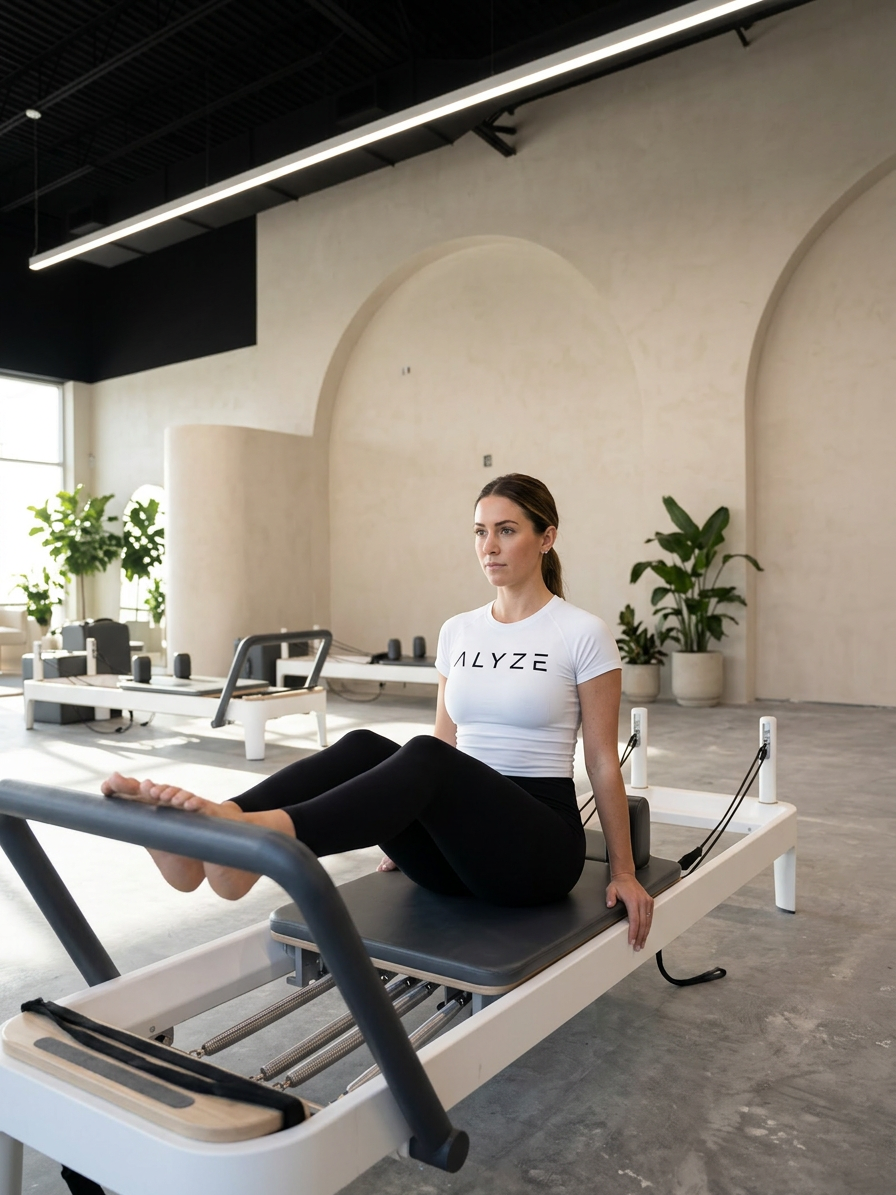
X-former Pilates has an image problem. In popular perception, it occupies a space somewhere between yoga and stretching — a low-intensity practice focused on flexibility, performed predominantly by dancers and rehabilitation patients. This perception is not just outdated; it is wrong. Modern research demonstrates that X-former Pilates is a legitimate resistance training modality that builds lean muscle, reduces body fat percentage, improves bone density, and produces measurable changes in body composition that rival traditional strength training for many populations.
The disconnect between perception and reality exists because Pilates does not look like traditional resistance training. There are no barbells, no grunting, no visible displays of maximal effort. What there is — variable resistance through spring tension, eccentric loading through controlled movement, and deep stabilizer recruitment through unstable surfaces — is precisely what makes it effective for body composition goals, particularly when integrated into a comprehensive training program.
The Pilates reformer is essentially a sophisticated resistance machine. A carriage moves along rails against resistance provided by calibrated springs. Different spring combinations create different resistance profiles — and unlike free weights, where resistance is constant (governed by gravity), the reformer provides variable resistance that changes throughout the range of motion. This variable loading pattern recruits muscle fibers in ways that constant resistance does not, engaging more stabilizer muscles and creating a more complete stimulus.
The reformer also excels at eccentric training — the controlled lengthening phase of a muscle contraction. When you slowly return the carriage to its starting position against spring tension, your muscles are performing eccentric work. Research in the British Journal of Sports Medicine has consistently shown that eccentric training produces greater hypertrophy (muscle growth) per unit of effort than concentric training alone, and generates less muscle damage per unit of mechanical work — meaning you can train more frequently with less recovery time.
The reformer does not build muscle despite its gentleness. It builds muscle because of it — through variable resistance, eccentric loading, and deep stabilizer recruitment that heavy barbell work often misses.
A 2016 study published in the Journal of Bodywork and Movement Therapies examined body composition changes in women who performed X-former Pilates three times per week for eight weeks. DEXA scans revealed significant increases in lean body mass, particularly in the trunk and lower extremities, along with reductions in body fat percentage. These changes were comparable to those seen in traditional resistance training programs of similar duration and frequency.
A larger study in the Journal of Sports Science and Medicine confirmed these findings and added an important detail: the lean mass gains were accompanied by improvements in muscular endurance and functional movement capacity that the strength-training comparison group did not match. In other words, Pilates built muscle and improved how that muscle functioned in real-world movement patterns.
While Pilates is not a high-calorie-burn activity in the traditional sense — a 50-minute reformer session burns roughly 250-350 calories depending on intensity — its effects on body fat are mediated through a different pathway: increased lean mass. Muscle tissue is metabolically active, burning calories at rest. Each pound of lean muscle added through consistent Pilates practice increases your basal metabolic rate, creating a compounding effect on fat loss that persists 24 hours a day, not just during exercise.
Research published in Complementary Therapies in Medicine demonstrated that 12 weeks of Pilates training produced significant reductions in waist circumference, hip circumference, and body fat percentage — even in the absence of dietary changes. The mechanism is straightforward: more muscle, higher metabolism, less fat over time.
This is an area where X-former Pilates deserves more attention than it receives. A study in the Journal of Aging and Physical Activity found that Pilates improved bone mineral density in postmenopausal women — a population at high risk for osteoporosis. The spring-based resistance of the reformer provides sufficient mechanical loading to stimulate osteoblast activity (bone-building cells), particularly in the spine and hip, without the joint impact associated with high-impact exercise or heavy barbell training.
For members focused on longevity, bone density is not optional. Falls and fractures are among the leading causes of disability and mortality in older adults, and maintaining bone density through resistance training is one of the most effective preventive strategies available. X-former Pilates offers a joint-friendly pathway to this critical goal.
One of the most significant — and least discussed — benefits of X-former Pilates is its ability to train the deep stabilizer muscles that conventional strength training often neglects. The transversus abdominis, multifidus, pelvic floor, and deep hip rotators form the functional core of your body. These muscles do not produce large, visible movements; they stabilize your spine, pelvis, and joints during every movement you make.
The reformer's moving carriage creates an inherently unstable surface. To perform exercises correctly, your deep stabilizers must engage constantly — they are not optional. This is fundamentally different from a stable bench press or leg press, where the machine stabilizes for you and the deep stabilizers can remain relatively dormant.
The practical implications are significant:
If your primary training involves heavy barbell work, X-former Pilates is not a replacement — it is a complement. The eccentric loading and stabilizer work address the imbalances and movement limitations that heavy compound lifts can create. Many powerlifters and Olympic weightlifters have integrated Pilates into their programs and reported improvements in mobility, recovery, and lift mechanics.
Runners, cyclists, and swimmers often develop significant muscle imbalances and core weakness that limit performance and increase injury risk. X-former Pilates addresses both issues simultaneously, building the trunk stability needed for efficient movement and correcting the asymmetries that repetitive unidirectional training creates.
For adults over 50, X-former Pilates may be one of the most appropriate resistance training modalities available. It provides sufficient intensity to build muscle and bone without excessive joint stress. The controlled movement environment reduces injury risk. And the balance and proprioception demands directly address fall risk — the single greatest physical threat to quality of life in older adults.
At ALYZE, we do not ask you to take our word for it. Every member's body composition journey is tracked objectively through DEXA scanning — the gold standard for measuring lean mass, fat mass, and bone density at the regional level. When you begin a X-former Pilates program, your baseline DEXA provides the starting point. Subsequent scans at 8 and 16 weeks show exactly what has changed — not in subjective mirror assessments, but in grams of lean tissue gained, percentage points of body fat lost, and bone density measurements that matter for your long-term health.
This data-driven approach is what separates training from optimization. You are not guessing whether Pilates is working. You are measuring it — and adjusting your protocol accordingly.
Bountiful, Utah · alyze.health
